
Natural Moisturizers for Sensitive Skin: Top 10 Picks
If you have sensitive skin, finding the right moisturizer feels like defusing a bomb. The wrong ingredient — a hidden fragrance, an aggressive botanical, a preservative you’ve never heard of — and your skin flares up within hours. Natural moisturizers for sensitive skin promise gentleness, but “natural” alone tells you almost nothing about whether a product will actually work without causing a reaction. This guide cuts through the noise with 10 carefully chosen options, a clear framework for evaluating them, and honest advice on what your skin actually needs to heal and stay hydrated.
Table of Contents
- Key takeaways
- How to choose natural moisturizers for sensitive skin
- 1. Grass-fed beef tallow balm
- 2. Colloidal oatmeal cream
- 3. Ceramide-rich moisturizing cream
- 4. Jojoba oil
- 5. Squalane moisturizer
- 6. Panthenol-based lotion
- 7. Milk and honey tallow balm
- 8. Glycerin-based gel moisturizer
- 9. Shea butter cream
- 10. Aloe vera gel moisturizer
- Comparison of top natural moisturizers for sensitive skin
- How to decide which moisturizer fits your skin
- My honest take on natural moisturizers for sensitive skin
- Why Shopsevaux is worth a look for sensitive skin
- FAQ
Key takeaways
| Point | Details |
|---|---|
| “Natural” isn’t automatically safe | Fragrance and essential oils, even from plants, are leading causes of contact dermatitis in sensitive skin. |
| Minimal ingredient lists win | Fewer ingredients mean fewer chances for your skin to react negatively. |
| Balance your moisturizer’s functions | Humectants, emollients, and occlusives each play a different role; you need all three working together. |
| Consistency beats intensity | Barrier repair takes 4 to 6 weeks of twice-daily application before you see measurable results. |
| Patch test every new product | Introduce one new product at a time and test it on a small area before full application. |
How to choose natural moisturizers for sensitive skin
Before you look at any product label, you need a framework. Otherwise, you’re just guessing.
The single most important filter is fragrance-free status. Fragrance, including natural essential oils, is one of the leading causes of contact dermatitis in people with sensitive skin. “Unscented” is not the same thing. Unscented products can still contain masking fragrances. Look specifically for “fragrance-free” on the label.
Next, understand the three jobs a moisturizer performs:
- Humectants (like glycerin and hyaluronic acid) pull water into the skin from the environment. They work brilliantly in humid conditions but can actually pull water out of your skin in dry climates if they’re not paired with something that seals the moisture in.
- Emollients (like jojoba oil and squalane) fill the gaps between skin cells, making skin feel smooth and soft.
- Occlusives (like petrolatum and tallow) form a physical barrier on the skin’s surface to prevent water from escaping. Petrolatum reduces transepidermal water loss by up to 99%, making it one of the most effective barrier protectors available.
The problem is that humectants alone can increase water loss if not combined with an occlusive, especially in low humidity. A balanced formula covers all three functions.
Also prioritize ingredients that rebuild your skin barrier directly. Ceramides, cholesterol, and fatty acids are the building blocks of your skin’s lipid layer. When that layer is compromised, irritants get in and moisture gets out. Replenishing these in the right ratios is what actually repairs the barrier over time.
Pro Tip: Opt for products with fewer than 10 ingredients when your skin is reactive. The shorter the list, the easier it is to identify what’s causing a flare-up if one occurs.
Finally, match texture to your skin’s dryness level. Lightweight lotions work for mild dryness. Richer creams and balms are better for chronically dry or severely reactive skin.
1. Grass-fed beef tallow balm
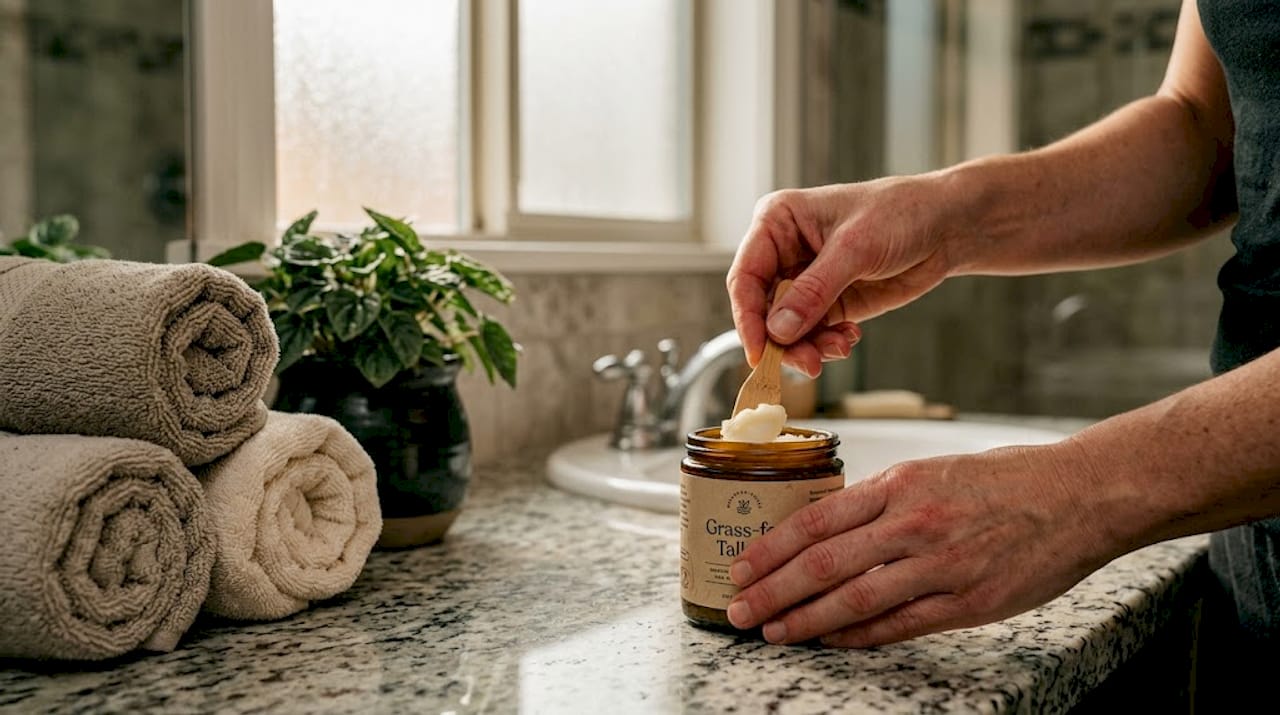
Tallow has been used as a skin protectant for centuries, and the reason it’s making a comeback is straightforward: its fatty acid profile closely mirrors the lipids in human skin. It contains oleic acid, palmitic acid, and stearic acid, all of which support barrier repair and deep hydration. Tallow is an occlusive and an emollient in one, making it particularly effective for very dry or reactive skin. The Unscented Tallow Balm from Shopsevaux uses only two ingredients: grass-fed beef tallow and jojoba oil. No fragrance, no fillers, no synthetic additives.
2. Colloidal oatmeal cream
Colloidal oatmeal is one of the few natural ingredients with FDA-approved skin protectant status. It works by forming a protective film over the skin while also delivering anti-inflammatory compounds called avenanthramides. Colloidal oatmeal provides soothing properties that are particularly beneficial for reactive or eczema-prone skin. Look for it as the active ingredient in fragrance-free creams, not just as a minor addition buried in the formula.
3. Ceramide-rich moisturizing cream
Ceramides make up roughly 50% of your skin’s outer barrier. When levels drop, skin becomes dry, tight, and prone to irritation. Ceramides and glycerin are core barrier-repairing ingredients that dermatologists consistently recommend for sensitive skin. A ceramide-rich cream applied twice daily works to restore the lipid mortar that holds skin cells together and keeps irritants out.
4. Jojoba oil
Jojoba is technically a wax ester, not an oil, which is why it behaves so differently from other plant-based options. It’s structurally similar to sebum, the skin’s own natural lubricant, which makes it exceptionally well tolerated even by reactive skin types. It’s non-comedogenic, lightweight, and stable. Use it alone as a facial moisturizer or look for it as a primary ingredient in a balm formula.
5. Squalane moisturizer
Squalane is a stable, plant-derived version of squalene, a lipid your skin naturally produces. It’s an excellent emollient that absorbs without leaving a greasy residue. Because it’s so close to what your skin already makes, it’s one of the least likely plant-based moisturizers to cause irritation. It works well for sensitive skin that also tends to be oily, since it hydrates without clogging pores.
6. Panthenol-based lotion
Panthenol, also known as provitamin B5, is a humectant and skin-conditioning agent with documented anti-inflammatory properties. Panthenol provides soothing benefits that make it a strong choice for reactive skin dealing with redness or irritation. It absorbs quickly, making it a good option for daytime use under sunscreen or makeup.
7. Milk and honey tallow balm
Milk and honey have a long history in traditional skin care, and for good reason. Milk contains lactic acid, a gentle exfoliant and humectant, while raw honey is a natural humectant with antimicrobial properties. Combined with tallow as a base, this creates a formula that hydrates, soothes, and supports barrier repair without synthetic ingredients. Shopsevaux’s Milk and Honey Tallow Balm pairs these traditional ingredients with grass-fed tallow for a rich, fragrance-free balm suited to dry and sensitive skin.
8. Glycerin-based gel moisturizer
Glycerin is one of the most studied humectants in skin care. Glycerin increases skin hydration by 16% in controlled studies, making it a dependable active for dry, sensitive skin. A glycerin-based gel works especially well in humid climates or for people whose skin is sensitive but not severely dry. The lightweight texture layers easily under other products without pilling.
9. Shea butter cream
Shea butter is rich in oleic and stearic fatty acids, giving it strong emollient and occlusive properties. It’s also high in triterpenes, compounds with documented anti-inflammatory activity. For people dealing with a natural moisturizer for sensitive rosacea or chronic dryness, unrefined shea butter in a fragrance-free base can be genuinely calming. Refined shea has a neutral scent and slightly lighter texture, while unrefined retains more of its active compounds.
10. Aloe vera gel moisturizer
Aloe vera gel is a lightweight humectant with cooling, anti-inflammatory properties. It’s one of the best natural lotions for sensitive skin that runs oily or combination, since it hydrates without adding heaviness. The key is finding a formula where aloe is the primary ingredient, not a minor addition. Avoid products that pair it with alcohol or fragrance, which would cancel out its benefits entirely.
Comparison of top natural moisturizers for sensitive skin
| Moisturizer | Primary function | Fragrance-free | Best for | Texture |
|---|---|---|---|---|
| Grass-fed tallow balm | Occlusive + emollient | Yes | Very dry, reactive skin | Rich balm |
| Colloidal oatmeal cream | Soothing + protective | Yes | Eczema, inflamed skin | Medium cream |
| Ceramide-rich cream | Barrier repair | Yes | Compromised barriers | Medium cream |
| Jojoba oil | Emollient | Yes | Most skin types | Lightweight oil |
| Squalane moisturizer | Emollient | Yes | Oily-sensitive skin | Lightweight |
| Panthenol lotion | Humectant + soothing | Yes | Redness, irritation | Light lotion |
| Milk and honey tallow balm | Occlusive + humectant | Yes | Dry, sensitive skin | Rich balm |
| Glycerin gel | Humectant | Yes | Mild dryness, humid climates | Gel |
| Shea butter cream | Emollient + occlusive | Check label | Rosacea, chronic dryness | Rich cream |
| Aloe vera gel | Humectant + soothing | Check label | Oily-sensitive, combo | Lightweight gel |
How to decide which moisturizer fits your skin
Start by identifying your two biggest skin concerns: dryness level and sensitivity triggers. If your skin gets tight and flaky, you need an occlusive-rich formula. If it’s more reactive than dry, a lighter option with soothing actives like panthenol or colloidal oatmeal may serve you better.
Your climate matters more than most people realize. In dry or cold environments, humectants without occlusives can backfire. In humid conditions, a heavy balm may feel suffocating. Match texture to your environment, not just your skin type.
When introducing any new product, follow this sequence:
- Apply a small amount to the inside of your wrist or behind your ear.
- Wait 24 to 48 hours and check for redness, itching, or swelling.
- If no reaction occurs, apply to a small area of your face for 3 to 5 days.
- Only then incorporate it into your full routine.
Patch testing and simplified routines are the most reliable way to identify personal irritants and support barrier healing. And remember that consistent twice-daily application over weeks is what drives barrier repair. One good application won’t undo months of damage.
Pro Tip: If your skin stings, burns, or breaks out within 48 hours of using a new product, stop immediately and give your skin at least a week to recover before trying anything else.
Stop using any product and consult a dermatologist if you notice persistent redness, swelling, or a spreading rash. These can signal contact dermatitis that needs professional treatment.
My honest take on natural moisturizers for sensitive skin
I’ve spent years watching people with sensitive skin chase complex botanical blends, convinced that more ingredients means more benefit. In my experience, the opposite is almost always true. The products that consistently work are the ones with the shortest ingredient lists and the clearest purpose.
The phrase “natural” is completely unregulated. Simpler ingredient lists reduce irritation risk far more reliably than any marketing claim. I’ve seen people react to lavender essential oil, rose hip seed oil, and tea tree extract, all of which are natural and all of which have no business being in a product marketed to sensitive skin.
What I’ve learned is that barrier repair is slow work. Measurable improvement takes 4 to 6 weeks of consistent use. Most people give up after two weeks because they don’t see dramatic results. The patience required is real, and it’s worth it.
I’m also skeptical of the texture-first approach. People often choose products based on how they feel in the first 30 seconds, not on what they do over 30 days. A balm that feels heavy at first may be exactly what a compromised barrier needs. Give your skin time to adjust before writing off a product as too rich.
The most underrated sensitive skin hydration tip I can offer: stop rotating products constantly. Pick one solid moisturizer, use it twice a day for six weeks, and actually assess the results. Your skin can’t heal if you keep changing the variables.
— Sayef
Why Shopsevaux is worth a look for sensitive skin
If the idea of a two-ingredient moisturizer appeals to you, Shopsevaux has built its entire product line around that principle. Their formulas contain only grass-fed beef tallow and jojoba oil. Nothing else. No synthetic preservatives, no fragrance, no seed oils, no filler ingredients.
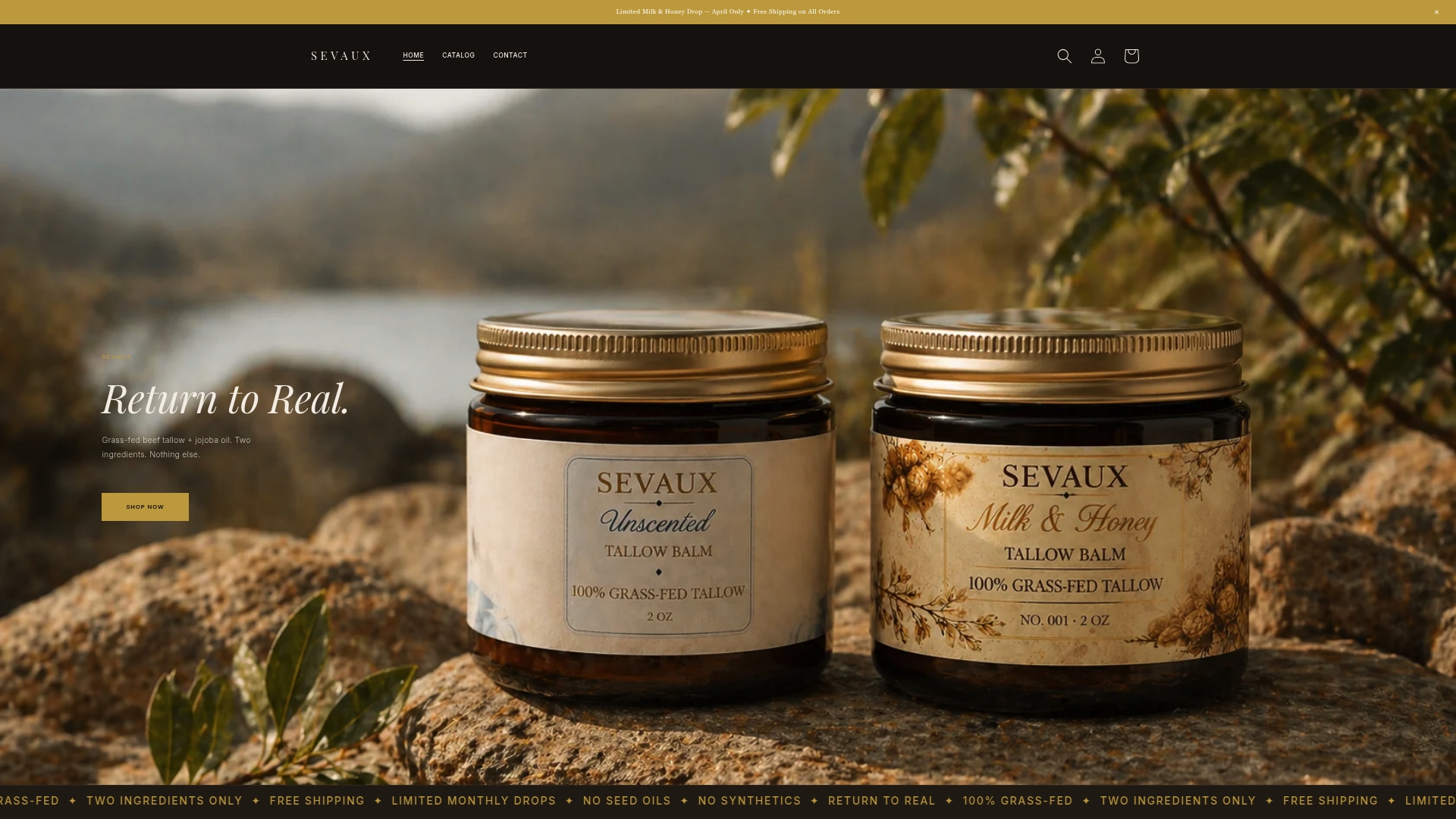
The Milk and Honey Tallow Balm adds traditional humectants to the tallow base for a richer, more hydrating formula suited to very dry or reactive skin. The Unscented Tallow Balm is the purest option, completely fragrance-free and ideal for anyone with contact allergies or extreme sensitivity. Both are sourced from ethically raised, grass-fed cattle, and both ship free. Shopsevaux operates on limited monthly drops, so availability is worth checking regularly. For the full range, visit the Shopsevaux collection and read through the customer reviews. The feedback from people with reactive skin is consistently strong.
FAQ
What makes a moisturizer safe for sensitive skin?
A safe moisturizer for sensitive skin is fragrance-free, contains minimal ingredients, and includes barrier-repairing actives like ceramides, glycerin, or fatty acids. Avoid essential oils, harsh alcohols, and lanolin if you have known sensitivities.
Is tallow good for sensitive skin?
Yes. Grass-fed beef tallow has a fatty acid profile that closely mirrors human skin lipids, making it an effective and well-tolerated occlusive and emollient for dry, sensitive, or reactive skin.
How long does it take for a natural moisturizer to repair the skin barrier?
Barrier repair typically requires 4 to 6 weeks of consistent twice-daily application before you see measurable improvement. Results are gradual, not immediate.
Can natural moisturizers help with rosacea?
A natural moisturizer for sensitive rosacea should be fragrance-free, free of essential oils, and rich in soothing ingredients like colloidal oatmeal, panthenol, or tallow-based fatty acids. Avoid anything with alcohol or strong botanicals.
Should I patch test organic moisturizers for sensitive skin?
Always. Even organic moisturizers for sensitive skin can contain botanical extracts that trigger reactions. Test on a small area for 24 to 48 hours before applying to your full face.