
Tallow balm for eczema skin: a natural how-to guide
Managing eczema means navigating an endless parade of products that promise relief but deliver irritation. If you’ve started looking at natural remedies for eczema, tallow balm has probably crossed your radar. It’s ancient, it’s simple, and the ingredient list won’t make your eyes glaze over. But tallow balm for eczema skin is not a guaranteed fix, and using it wrong can make your skin angrier than before. This guide breaks down exactly what tallow balm is, how to use it safely, what the science actually says, and what realistic results look like.
Table of Contents
- Understanding tallow balm and its role in eczema care
- Preparing to use tallow balm safely on eczema skin
- How to apply tallow balm for eczema: step-by-step instructions
- Monitoring effects and troubleshooting common issues
- What to expect from tallow balm use for eczema skin
- A balanced perspective on tallow balm for eczema skin
- Explore high-quality tallow balms designed for eczema skin
- Frequently asked questions
Key Takeaways
| Point | Details |
|---|---|
| Tallow balm basics | Tallow balm is rendered beef fat with fatty acids that might lock in moisture but scientifically lacks strong proof as an eczema treatment. |
| Patch test first | Always patch test tallow balm on a small skin area for 48 hours to check for irritation or allergic reactions before widespread use. |
| Not for all skin types | Avoid tallow balm if you have oily, sensitive, or acne-prone skin due to pore clogging and possible worsening of symptoms. |
| Use as complementary moisturizer | Tallow balm can help seal in moisture when used with prescribed eczema treatments but should not replace medical skincare. |
| Choose quality products | Select grass-fed, minimally processed tallow balms with transparent ingredients to maximize potential benefits and safety. |
Understanding tallow balm and its role in eczema care
Tallow balm is rendered animal fat, typically from grass-fed beef, that has been purified and sometimes blended with a small number of complementary ingredients. It functions as an occlusive moisturizer, meaning it creates a physical barrier on the skin’s surface to slow water loss rather than actively adding moisture. For eczema skin, which struggles to retain hydration due to a compromised skin barrier, that sealing effect is the core appeal.
The fatty acid profile is what makes tallow theoretically interesting for eczema care. It contains:
- Oleic acid (a monounsaturated fat that penetrates skin deeply but may increase water loss in some individuals)
- Stearic acid (a saturated fat that supports skin barrier structure)
- Palmitic acid (a saturated fat that helps maintain the lipid layer of the skin)
- Conjugated linoleic acid (CLA) and fat-soluble vitamins A, D, E, and K in quality grass-fed sources
The fatty acid profile of tallow closely mirrors healthy human sebum, which is the skin’s own natural oil. That biocompatibility is why many people with eczema report it absorbs better than heavy petroleum-based products without leaving a suffocating film.
Here’s where it gets nuanced. Oleic acid, while skin-penetrating, may increase skin water loss and worsen dryness in some eczema cases. This is not a minor footnote. For eczema skin that is already losing water faster than it should, an ingredient that speeds that process could backfire. No large-scale clinical trials have confirmed tallow balm’s efficacy for eczema, so the evidence base right now is largely anecdotal and theoretical.
That doesn’t mean tallow balm is useless. It means you need to use it with clear eyes and a smart approach. Starting with a quality unscented tallow balm with minimal added ingredients is the safest entry point for eczema skin.
Now that we know what tallow balm is, let’s discuss how to prepare for its safe use on eczema skin.
Preparing to use tallow balm safely on eczema skin
Not all tallow balms are the same, and the gap between a well-sourced product and a poorly processed one matters enormously for sensitive skin. Before you apply anything to an eczema flare, preparation is everything.
What to look for when choosing a tallow balm:
- Grass-fed and finished beef tallow as the primary ingredient
- Short, transparent ingredient lists with no synthetic fragrances, parabens, or seed oils
- No added essential oils unless you have confirmed you tolerate them
- Cold-processed or minimally rendered to preserve fat-soluble vitamins
- Unscented options specifically designed for sensitive or reactive skin
A product like milk honey tallow balm adds gentle, skin-compatible ingredients to the base formula, but if your skin is at peak reactivity, starting with a completely unscented version is the smarter move.
Skin type suitability at a glance:
| Skin type | Tallow balm suitability | Notes |
|---|---|---|
| Very dry, non-acne-prone | High | Best candidate for tallow balm |
| Normal to dry | Moderate | Patch test first, use sparingly |
| Oily or combination | Low | Pore-clogging risk is real |
| Acne-prone | Not recommended | Can trigger breakouts |
| Sensitive without acne | Moderate | Patch test is non-negotiable |
Patch testing for 48 hours on the inner forearm before applying tallow balm to eczema patches is essential, even with minimal formulas. Sensitive individuals can react to ingredients that seem completely benign.
Pro Tip: Apply your patch test to the inner forearm, not the wrist. The inner forearm skin is thin and reactive enough to give you an accurate read without being as exposed or variable as the face or neck.
With preparation done, let’s review how to apply tallow balm effectively for eczema relief.
How to apply tallow balm for eczema: step-by-step instructions
Application technique matters more than most people realize. Tallow balm applied incorrectly, too much, too often, or at the wrong time relative to other treatments, can underperform or cause problems.
- Cleanse gently. Wash the affected area with a fragrance-free, pH-balanced cleanser. Pat dry with a soft towel, leaving the skin slightly damp, not soaking wet.
- Apply any prescription treatments first. If you use topical corticosteroids or other prescribed eczema medications, apply them directly to clean skin and allow them to fully absorb before adding any balm layer. Tallow applied on top of medication that hasn’t absorbed yet can interfere with penetration.
- Use a pea-sized amount. Warm a small amount between your fingertips before applying. Tallow balm is dense, and a little goes a long way. Using too much creates an uncomfortable, greasy layer that can trap heat and irritate inflamed skin.
- Apply to damp skin. The slight moisture on the skin surface gives the balm something to seal in. This is the same principle behind the “soak and seal” method recommended by dermatologists for eczema management.
- Avoid broken or actively weeping skin. Tallow balm is not a wound treatment. Applying it to open eczema lesions can trap bacteria and worsen infection risk.
- Repeat once or twice daily. Morning and evening application is typically sufficient. More frequent use is rarely necessary and increases the chance of buildup or irritation.
Pro Tip: If you apply tallow balm before bed, wear light cotton gloves or socks over treated hands or feet. The occlusion effect amplifies overnight, and you’ll wake up with noticeably softer skin without the balm rubbing off on your sheets.
For the cleanest experience with eczema-prone skin, an unscented tallow balm with no added botanicals reduces the number of variables in your skin’s reaction.

After learning the correct application method, it’s important to know how to monitor your skin’s response.
Monitoring effects and troubleshooting common issues
Your skin will tell you quickly whether tallow balm is working for it. The challenge is knowing what signals to watch for and when to act on them.
Signs to watch in the first 48 to 72 hours:
- Redness or warmth that wasn’t present before application
- New or increased itching at the application site
- Burning or stinging sensation
- Small bumps or new breakouts appearing on or near treated areas
- Skin that feels tighter or drier after the balm absorbs
If any of these appear, stop use immediately. Oleic acid in tallow can increase water loss and worsen dryness in some eczema cases, and heavy products like tallow can aggravate sensitive or acne-prone skin even when the ingredient list looks clean.
“Heavy, occlusive products are not universally beneficial for eczema skin. The skin’s response in the first few days of use is the most reliable indicator of whether a product is helping or hurting.”
One thing tallow balm does not do: protect against sun damage. If you are applying it to exposed areas, you still need a separate SPF product. Tallow provides no UV protection, and the fat-soluble vitamins it contains do not substitute for sunscreen.
If your skin shows no improvement after two weeks of consistent, correct use, that’s a clear signal to consult a dermatologist rather than continuing to experiment. A milk honey tallow balm with added skin-soothing ingredients may suit some users better than a plain tallow base, but neither is a substitute for professional guidance when eczema is severe.
Understanding potential issues prepares you for knowing what results to expect with proper use.
What to expect from tallow balm use for eczema skin
Realistic expectations are the difference between a useful tool and a disappointing experiment. Here’s what tallow balm can and cannot do for eczema skin.
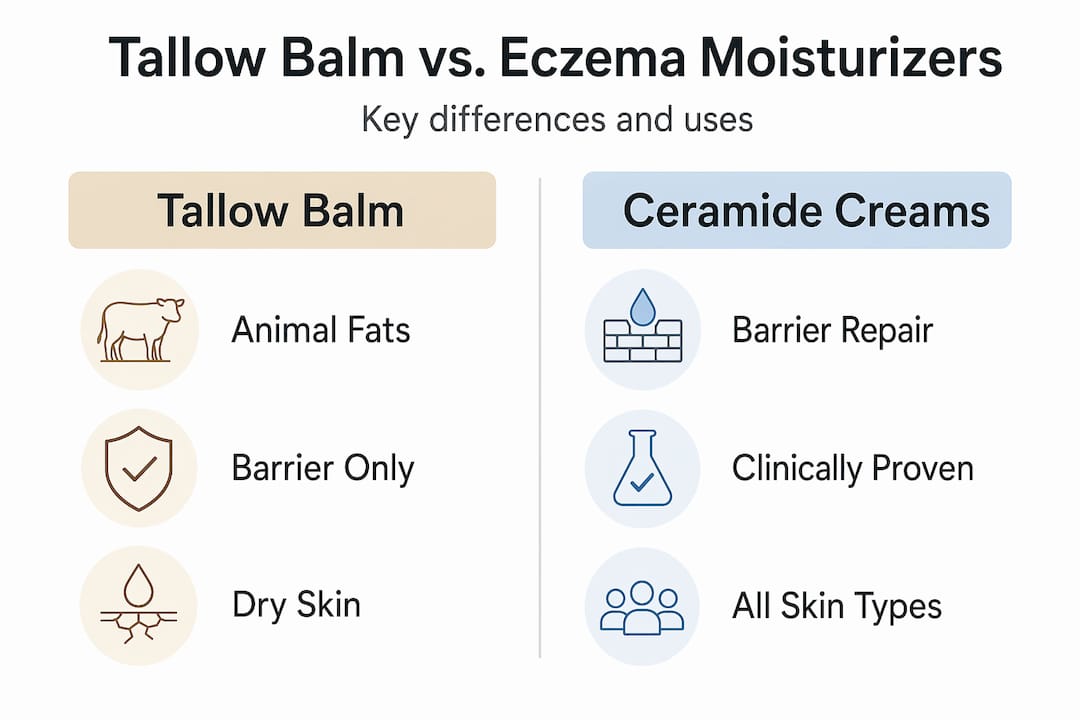
Tallow balm vs. ceramide-based moisturizers: a comparison
| Feature | Tallow balm | Ceramide-based moisturizer |
|---|---|---|
| Mechanism | Occlusive barrier | Barrier repair and hydration |
| Clinical evidence for eczema | Limited, anecdotal | Strong, well-researched |
| Ingredient simplicity | High (minimal formulas) | Variable |
| Risk of irritation | Moderate (oleic acid) | Low with fragrance-free options |
| Fat-soluble vitamins | Present in grass-fed sources | Typically absent |
| Suitable for acne-prone skin | No | Yes, with correct formulation |
Users typically report 2 to 4 weeks of consistent use before noticing meaningful skin barrier improvements. That timeline is realistic for any occlusive moisturizer. You are not treating the underlying immune response driving eczema. You are supporting the skin’s ability to hold onto moisture while that response is managed through other means.
No large-scale randomized controlled trials currently confirm tallow’s efficacy for eczema. That’s not a reason to dismiss it entirely, but it is a reason to treat it as a complementary tool rather than a primary treatment. Use it alongside your dermatologist’s recommendations, not instead of them.
Pro Tip: Track your skin with weekly photos taken in the same lighting. Gradual improvements are easy to miss day to day but become obvious when you compare week one to week four.
Having explored what to expect, let’s add our unique perspective on tallow balm’s role in eczema care.
A balanced perspective on tallow balm for eczema skin
Here’s something the tallow balm conversation tends to skip: the product quality gap is enormous, and it changes everything about whether your experience will be positive or negative.
A poorly sourced tallow, rendered at high heat, stripped of its fat-soluble vitamins, and blended with fragrance or seed oils, shares almost nothing in common with a cold-processed, grass-fed tallow with two clean ingredients. When someone says “tallow made my eczema worse,” the product they used matters as much as the ingredient itself. This is not a defense of tallow as a category. It’s a reminder that sourcing and processing are variables most reviews don’t account for.
The other thing worth saying plainly: tallow balm is genuinely interesting for very dry, non-acne-prone eczema skin. Its sebum-like composition is not marketing language. It’s a real property that explains why some people with severely dry, flaky eczema patches find it more comfortable than thick synthetic creams. But Dr. Wei notes that risks like breakouts and the lack of proven vitamin absorption make tallow less favorable than regulated moisturizers for many people.
The honest answer is that tallow balm works well as a complementary moisturizer for a specific subset of eczema sufferers. Those with very dry, non-oily skin who have already confirmed they tolerate it through patch testing, who use it alongside medical treatment rather than instead of it, and who source it from a transparent, quality-focused producer. That’s a narrower group than the tallow balm community online might suggest.
If you fall outside that profile, a fragrance-free ceramide moisturizer with solid clinical backing is a lower-risk starting point. If you fall inside it, a milk honey tallow balm or a plain unscented version from a trusted source is worth a careful, monitored trial.
Explore high-quality tallow balms designed for eczema skin
If you’ve done your patch test, confirmed your skin type is a good fit, and you’re ready to try tallow balm as part of your eczema care routine, the product you choose matters.
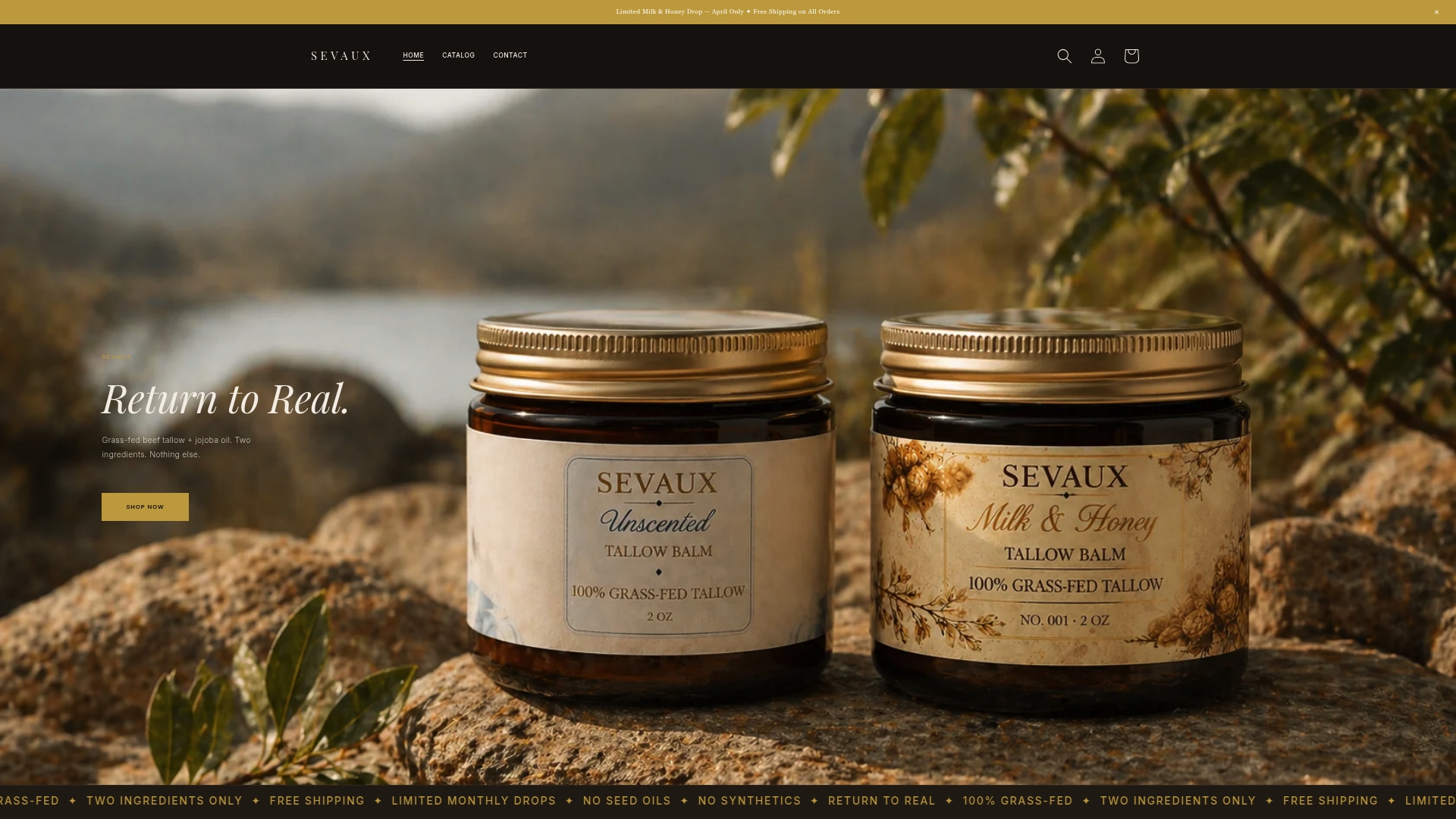
Sevaux formulates its tallow balms with exactly two ingredients: grass-fed beef tallow and jojoba oil. No synthetic fragrances, no seed oil fillers, no ingredient lists that require a chemistry degree to decode. The unscented tallow balm is designed specifically for sensitive and reactive skin, while the milk honey tallow balm adds gentle, skin-compatible ingredients for those who tolerate a slightly richer formula. Both are sourced from ethically raised, grass-fed cattle with full transparency about what goes into every batch. Free shipping is included. Visit Sevaux to shop the current drop and read verified customer experiences from people managing real skin concerns.
Frequently asked questions
Is tallow balm recommended by dermatologists for eczema?
Dermatologists generally do not recommend tallow balm as a primary eczema treatment, favoring proven ceramide-based moisturizers with stronger clinical evidence and lower irritation risk instead.
Can tallow balm cause irritation or worsen eczema symptoms?
Yes, it can. Oleic acid in tallow may increase skin water loss and worsen dryness in some eczema cases, which is why patch testing before full application is non-negotiable.
How should I test tallow balm for skin reactions before using it widely?
Apply a small amount to the inner forearm and wait 48 hours to check for redness, itching, or swelling before applying it to any eczema-affected areas.
Are there better moisturizing alternatives to tallow balm for eczema?
For most eczema sufferers, yes. Fragrance-free, ceramide-rich moisturizers with established clinical backing are typically the safer, better-supported first choice for eczema-prone skin.